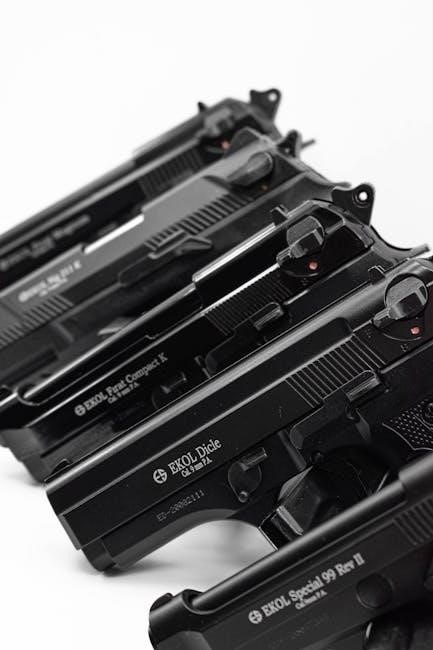
Beretta 92FS Guide Rod: A Comprehensive Guide (Updated 05/04/2026)
Today, 05/04/2026, we delve into the Beretta 92FS guide rod, exploring its function, materials, history, and upgrades—primarily aesthetic, with minimal recoil impact;
The Beretta 92FS guide rod, often a subject of debate among enthusiasts, is a seemingly small component with a surprisingly nuanced role within the pistol’s operating system. While often perceived as a quality-of-life or aesthetic upgrade, its primary function revolves around maintaining proper recoil spring alignment and preventing potential binding issues. Historically, the original metal guide rods were sometimes prone to bending under impact, potentially rendering the firearm inoperable, especially in field conditions.
This led to the introduction of the fluted polymer guide rod, designed to offer greater resilience against bending and mitigate binding caused by debris accumulation within the dust cover; It’s important to understand that the guide rod isn’t a load-bearing component; it simply ensures the recoil spring compresses in a straight line. Upgrades, like those offered by Wilson Combat, primarily cater to models with captive recoil spring systems, allowing for spring weight adjustments. For standard models, the benefits are largely perceptual, with recoil reduction being negligible and attributed more to the falling locking block design.
What is a Guide Rod and its Function?
The guide rod within the Beretta 92FS is a cylindrical component situated beneath the recoil spring, serving as a central axis for the spring’s movement during the firearm’s recoil cycle. Its fundamental function isn’t to bear significant load, but rather to maintain the alignment of the recoil spring, ensuring it compresses and expands smoothly and consistently. This prevents the spring from buckling or binding against the internal components of the slide, which could lead to malfunctions.
Essentially, it acts as a track for the spring. The design evolved from a solid metal rod to a fluted polymer version, primarily to address concerns about bending under stress and potential binding caused by dirt or debris. While a metal rod offers a perceived sense of robustness, the polymer version’s flexibility allows it to either retain its shape or break cleanly, still permitting slide movement and disassembly. The guide rod’s effectiveness is intrinsically linked to the Beretta 92FS’s falling locking block system, which handles the majority of recoil mitigation.
Beretta 92FS Original (Factory) Guide Rod
The original, factory-issued guide rod for the Beretta 92FS was constructed from solid metal. However, Beretta transitioned to a fluted polymer guide rod to address reported issues of bending and potential malfunctions. Soldiers were reportedly bending the metal rods by dropping or impacting the firearm with the slide locked back, potentially rendering it inoperable or difficult to disassemble in field conditions.
The polymer guide rod offered a solution: it either maintains its form or fractures cleanly upon impact, allowing continued slide operation and disassembly, albeit requiring replacement. This change wasn’t driven by a need for recoil reduction – the weight difference is negligible and any perceived reduction is largely placebo – but by enhancing durability and reliability in harsh environments. The factory polymer rod’s fluting aids in preventing spring binding, particularly when contaminants enter the dust cover area during reassembly. It’s a practical, albeit subtle, improvement focused on preventing operational failures.
Materials: Polymer vs. Metal Guide Rods
The choice between polymer and metal Beretta 92FS guide rods largely centers on perceived benefits rather than substantial performance gains. Metal rods, often stainless steel, are favored for their aesthetic appeal – contributing to an “all-metal” feel – and a sense of increased quality. However, they carry a risk of bending under significant impact, potentially causing malfunctions and disassembly difficulties, as experienced by some military personnel.
Polymer rods, conversely, prioritize durability in adverse conditions. While they can break, they do so predictably, allowing the firearm to remain functional for disassembly and continued use after replacement. They also offer a degree of friction reduction due to their design, potentially mitigating spring binding. Ultimately, neither material significantly impacts recoil; the falling locking block system handles the majority of recoil mitigation. The decision often boils down to personal preference and intended use, with metal leaning towards aesthetics and polymer towards practical reliability.
Polymer Guide Rod Advantages & Disadvantages
Polymer guide rods for the Beretta 92FS offer notable advantages in terms of resilience against bending and breakage from impacts. If a polymer rod does fail, it tends to snap cleanly, crucially allowing the slide to continue functioning and the firearm to remain field-strippable – a significant benefit in demanding situations. Their fluted design was specifically introduced to minimize spring binding, particularly when dirt or sand contaminates the dust cover area during reassembly.
However, polymer rods lack the perceived robustness of metal alternatives and are often viewed as less aesthetically pleasing. While they don’t demonstrably reduce recoil, some users report a subjective feeling of increased smoothness. A key disadvantage is the eventual need for replacement after wear or breakage. The material’s inherent flexibility can also lead to a slight reduction in overall system rigidity compared to a solid metal rod, though this is generally considered negligible in practical application.
Metal Guide Rod Advantages & Disadvantages

Metal guide rods, typically stainless steel, present a perceived upgrade in durability and aesthetics, contributing to an “all-metal” feel for the Beretta 92FS. Many shooters favor the solid construction, believing it enhances the firearm’s overall quality, though this is largely psychological. They offer no significant recoil reduction; any perceived difference is likely placebo, with the falling locking block system being far more impactful in mitigating felt recoil.
However, metal guide rods can introduce potential drawbacks. A slightly smaller diameter is sometimes necessary to accommodate the recoil spring’s movement, potentially leading to binding issues, especially during reassembly. Reports suggest that some metal rods can contribute to short-stroking if not properly fitted. While robust, they are susceptible to bending under extreme stress, potentially rendering the firearm inoperable and difficult to disassemble – a scenario the polymer rod avoids by simply breaking.

The History of Guide Rod Changes in the Beretta 92FS
The Beretta 92FS initially featured a solid metal guide rod. However, concerns arose regarding potential bending or damage if the firearm was dropped or impacted with the slide locked back, potentially causing disassembly issues. This led to the introduction of a fluted polymer guide rod as a factory option. The fluting was specifically designed to help prevent the recoil spring from binding, particularly if dirt or sand infiltrated the dust cover during reassembly – a common issue in harsh environments.
This change wasn’t necessarily about recoil reduction or increased longevity, but rather about improving reliability and preventing catastrophic failure in adverse conditions. The polymer rod, while less visually appealing to some, offered a safeguard: it would either retain its shape or break cleanly, allowing the slide to still function and the gun to be disassembled, albeit requiring replacement. The shift reflected a focus on practical field reliability over perceived quality or aesthetics.
Addressing Common Concerns: Binding and Durability

A frequent concern with Beretta 92FS guide rods revolves around potential binding, especially when upgrading to metal replacements. Some users report experiencing short-stroking after installing stainless steel guide rods, suggesting a slightly smaller diameter might be the cause. This reduced diameter allows the recoil spring more room to compress and move, but can create issues with the original slide tolerances.
Durability is another key point. While metal rods offer a robust feel, the original polymer design was intentionally chosen for its ability to either withstand impact or fail gracefully. A broken polymer rod doesn’t render the firearm inoperable, unlike a bent metal rod. The fluting on polymer rods also aids in preventing spring binding within the dust cover. Ultimately, the perceived need for increased durability often outweighs the practical benefits, especially considering the falling locking block system already mitigates significant recoil stress.
Recoil Reduction: Does the Guide Rod Matter?
The impact of the Beretta 92FS guide rod on recoil reduction is, largely, negligible. Despite popular belief, the weight difference between polymer and metal guide rods is insufficient to create a noticeable change in felt recoil. Many attribute any perceived reduction to the placebo effect, focusing on the psychological impact of a heavier component rather than actual physics.
The Beretta 92FS’s recoil mitigation is primarily handled by its ingenious falling locking block design. This system effectively delays the opening of the slide, lengthening the dwell time and spreading out the recoil impulse over a longer period. If recoil remains a concern, more substantial modifications – such as installing a Brigadier slide for added weight or utilizing lighter ammunition – will yield far more significant results than simply swapping the guide rod. The guide rod’s primary function isn’t recoil absorption, but spring alignment.
The Role of the Falling Locking Block System
The Beretta 92FS’s falling locking block system is paramount in managing recoil, far exceeding the influence of the guide rod itself. This innovative design delays the slide’s rearward movement, effectively lengthening the action’s dwell time. This extended period allows the pressure from the expanding gases to dissipate more gradually, resulting in a smoother and more controlled recoil experience for the shooter.
Unlike designs where the slide unlocks immediately upon reaching peak pressure, the falling block maintains a secure lockup for a crucial moment longer. This delay spreads the recoil impulse over a greater distance, reducing the peak force felt by the shooter; Consequently, focusing on optimizing the locking block system – ensuring proper function and lubrication – provides a more substantial recoil-reducing benefit than pursuing guide rod upgrades. The guide rod simply maintains spring alignment; the locking block manages recoil.
Wilson Combat Guide Rods for Beretta 92FS
Wilson Combat guide rods offer a practical advantage primarily for Beretta 92A1 and 96A1 models utilizing a captive recoil spring system. These rods enable users to easily adjust spring weight, tailoring recoil characteristics to their preference, or simply replace a worn-out spring without complete disassembly. This is a significant benefit for those seeking customization and reliability.
However, for standard Beretta 92FS models with non-captive springs, the value proposition diminishes considerably. The upgrade becomes largely unnecessary, offering minimal functional improvement for a cost of around $20. The guide rod’s primary role is to maintain spring alignment, a function adequately fulfilled by the factory polymer or aftermarket polymer options. Investing in a Wilson Combat rod for these models is often considered an aesthetic choice rather than a performance enhancement, as the impact on recoil is negligible.
Captive vs. Non-Captive Recoil Spring Systems
Understanding the difference between captive and non-captive recoil spring systems is crucial when considering a Beretta 92FS guide rod upgrade. Captive systems, found in models like the 92A1 and 96A1, enclose the recoil spring within the guide rod itself. This allows for easy spring weight adjustments and replacement, making aftermarket guide rods like those from Wilson Combat particularly valuable for tuning recoil and maintaining optimal function.

Conversely, non-captive systems, prevalent in standard 92FS models, have the recoil spring separate from the guide rod. In these configurations, the guide rod primarily serves to align the spring during compression. Upgrading to a metal guide rod offers little practical benefit, as it doesn’t significantly alter recoil or improve reliability. The spring’s movement and function remain largely unaffected, making the upgrade primarily aesthetic. The system’s design dictates the guide rod’s role and potential for improvement.
Guide Rods for 92A1 and 96A1 Models
Beretta 92A1 and 96A1 models utilize a captive recoil spring system, significantly altering the role and importance of the guide rod compared to standard 92FS pistols. Because the spring is contained within the guide rod, aftermarket options, such as those offered by Wilson Combat, become genuinely functional upgrades. These allow shooters to easily swap out recoil springs of varying weights, tailoring the firearm’s performance to their preferences and ammunition choices.
This capability is particularly useful for competition shooting or adjusting for different loads. Replacing a worn or fatigued captive spring is also simplified with an upgraded guide rod assembly. Unlike the largely aesthetic upgrade on non-captive systems, a quality guide rod for a 92A1/96A1 directly impacts recoil management and long-term reliability, offering a tangible performance enhancement. It’s a worthwhile investment for owners of these specific Beretta models.

Diameter Differences: Polymer vs. Stainless Steel
A subtle, yet potentially impactful, difference exists between polymer and stainless steel guide rods concerning their diameters. Reports suggest stainless steel guide rods often possess a slightly smaller diameter compared to their polymer counterparts. This seemingly minor variation is intentional, designed to provide the recoil spring with additional space to compress, bunch up, and move freely within the slide’s guide rod channel.
The larger surface area of the polymer guide rod, with its inherent flexibility, inherently offers less room for the spring to operate. Conversely, the reduced diameter of the stainless steel rod aims to mitigate potential binding issues during the spring’s compression and expansion cycle. Some users have experienced binding and short-stroking after installing a stainless steel rod, suggesting careful fitting or spring selection may be necessary to ensure proper function. This diameter difference highlights a key consideration when choosing between materials.
Potential Binding Issues with Metal Guide Rods
While often sought for perceived quality, metal guide rods in the Beretta 92FS can, in some instances, introduce binding issues. This isn’t a universal problem, but a reported experience for certain users after installation. The potential for binding stems from the tighter tolerances and reduced space afforded to the recoil spring when compared to the original polymer guide rod.
If the stainless steel guide rod’s diameter is too close to the inner dimensions of the slide’s guide rod channel, the spring may encounter resistance during compression and expansion, leading to a “short stroke” – where the slide doesn’t fully cycle. This can result in malfunctions. The reliefs present in the plastic guide rod offer more room to negate friction, something the metal version may lack. Careful inspection and potentially spring adjustments are crucial to avoid these issues, ensuring smooth and reliable operation.
Aesthetic Upgrades: The All-Metal Beretta 92FS
For some Beretta 92FS owners, the appeal of an all-metal guide rod extends beyond functionality, becoming a purely aesthetic upgrade. The desire to eliminate the polymer component and achieve a fully metallic feel and appearance drives this modification. It contributes to a perceived increase in the firearm’s overall quality and robustness, even if the practical benefits are minimal.
This upgrade is often undertaken simply to complete the visual aesthetic of the pistol, aligning with a preference for a more traditional or premium look. While it doesn’t demonstrably improve performance or recoil management, the satisfaction of having a completely metal-framed and internally-componented 92FS is a valid reason for many enthusiasts. It’s a cosmetic change that caters to individual preferences and a desire for a refined firearm presentation.
Testing Guide Rod Integrity: The Melt Test
A somewhat unconventional, yet discussed, method for assessing a polymer guide rod’s composition involves a “melt test.” This involves applying heat to a small portion of the guide rod to observe its behavior. The intention is to determine if the polymer is of a quality that will simply deform or if it will cleanly melt, indicating a potentially inferior material.
Videos showcasing this test have circulated among Beretta 92FS enthusiasts, though it’s not a scientifically rigorous method. The test aims to demonstrate that a quality polymer guide rod will resist melting easily, while a lower-quality one might quickly liquefy. However, the results can be subjective and dependent on the heat source and polymer type.
It’s important to note that this test is destructive and renders the guide rod unusable. While it can offer a visual indication of material quality, it doesn’t guarantee long-term durability or performance.
Guide Rod Replacement: A Step-by-Step Guide
Replacing the Beretta 92FS guide rod requires basic disassembly skills. First, ensure the firearm is unloaded and perform a visual and physical check. Remove the slide from the frame. Next, carefully remove the recoil spring by depressing the guide rod head and sliding the assembly forward off the barrel lug.
With the recoil spring removed, the old guide rod can be extracted. Insert the new guide rod, ensuring the correct orientation. Compress the recoil spring and carefully guide it over the barrel lug and onto the guide rod. This can require some force, so ensure a firm grip.
Finally, reassemble the slide onto the frame and perform a function check to verify proper operation. If binding occurs, double-check the spring’s seating and guide rod alignment. Remember, a properly installed guide rod allows smooth slide movement.
Troubleshooting: Short Stroking and Malfunctions

Short stroking, where the slide doesn’t fully return to battery, can sometimes be linked to guide rod issues. A slightly undersized metal guide rod might allow excessive spring compression, hindering complete cycling. Conversely, a bent or damaged guide rod will definitely cause malfunctions.
If experiencing short stroking after a guide rod replacement, first verify the recoil spring is correctly seated and has sufficient power. Inspect the guide rod for any bends or deformities; Ensure the slide rails are clean and properly lubricated, as friction can exacerbate the problem.
Binding can also lead to malfunctions. If the guide rod feels tight during disassembly or reassembly, it may be too large in diameter, causing friction. Consider returning to the original polymer guide rod if issues persist, as they often offer better tolerance.
Choosing the Right Guide Rod for Your Needs
Selecting the appropriate Beretta 92FS guide rod hinges on your priorities. For most users, the factory polymer guide rod is perfectly adequate, offering reliable function and preventing spring binding. Upgrading to metal primarily serves aesthetic purposes, creating an all-metal feel.
If you own a 92A1 or 96A1 with a captive recoil spring, a Wilson Combat guide rod becomes valuable, allowing for adjustable spring weights and easy replacement of worn components. However, for standard models with non-captive springs, the cost isn’t justified.
Consider your usage. Frequent handling and potential drops might benefit from the polymer rod’s resilience – it’s less likely to bend, even if it breaks. If recoil reduction is your goal, focus on a heavier slide or lighter ammunition; the guide rod has minimal impact. Prioritize proper function over perceived improvements.
Cost Comparison: Factory, Polymer, and Metal Options
The cost of Beretta 92FS guide rods varies significantly based on material and brand. A factory replacement polymer guide rod is the most economical option, typically ranging from $10 to $20. These are readily available from Beretta parts suppliers and online retailers.
Aftermarket polymer guide rods, often offering fluted designs, generally fall within the $15 to $30 price range. Metal guide rods represent the higher end of the spectrum. A basic stainless steel guide rod can cost between $30 and $50.
Wilson Combat guide rods, particularly those designed for 92A1/96A1 models with captive springs, are the most expensive, often exceeding $60. Considering the minimal functional benefit of a metal rod for standard models—around a $20 non-upgrade—the cost-benefit ratio is questionable. Focus spending on essential components instead.
Impact on Field Stripping and Disassembly
Generally, swapping the Beretta 92FS guide rod doesn’t significantly complicate field stripping or disassembly. The process remains largely the same, regardless of whether you’re using the factory polymer rod, an aftermarket polymer version, or a metal replacement.
However, potential binding issues with some metal guide rods – particularly if the diameter is slightly off – can make disassembly more challenging. This is because the recoil spring may not compress and seat correctly, hindering slide removal.
A broken polymer guide rod, while requiring replacement, doesn’t prevent disassembly; the slide remains free to move. Captive spring systems, like those in the 92A1, benefit from easier spring changes with upgraded rods. Ultimately, a properly fitted guide rod shouldn’t impede the standard Beretta 92FS disassembly procedure.
Longevity and Wear: When to Replace Your Guide Rod
The Beretta 92FS polymer guide rod exhibits impressive longevity, often outlasting other components. However, inspect it periodically for cracking or deformation, especially after dropping the firearm or experiencing hard impacts. A snapped polymer rod doesn’t render the gun unusable, but necessitates immediate replacement to maintain full functionality.
Metal guide rods, being more robust, are less prone to outright breakage. However, repeated use can cause bending, particularly if subjected to stress. Captive recoil spring systems, found in models like the 92A1, require monitoring the spring’s tension; the guide rod may need replacement alongside a weakened spring.
Generally, replace the guide rod if you notice binding during disassembly, or if it visibly deviates from its original shape. Proactive replacement during major maintenance is also advisable, ensuring continued reliable operation.
Resources for Beretta 92FS Parts and Information
For sourcing Beretta 92FS guide rods and related parts, several reputable vendors exist. MidwayUSA and Brownells consistently stock a variety of options, including factory, polymer, and metal upgrades like those from Wilson Combat. These sites also offer detailed schematics for identifying the correct part for your specific model (92FS, 92A1, 96A1).
Beretta’s official website (www.beretta.com) provides exploded views and parts lists, though direct purchasing may be limited. Online Beretta forums, such as BerettaTalk.com, are invaluable resources for troubleshooting, user reviews, and identifying potential binding issues with aftermarket guide rods.
YouTube channels dedicated to firearms maintenance, like those from experienced gunsmiths, often feature Beretta 92FS disassembly and upgrade guides. Remember to verify information across multiple sources before making any modifications.
Final Thoughts: Is a Guide Rod Upgrade Worth It?
Ultimately, a Beretta 92FS guide rod upgrade is largely a matter of personal preference and priorities. While metal guide rods offer a perceived increase in quality and a fully-metal aesthetic, they don’t demonstrably improve performance or significantly reduce recoil. The falling locking block system handles the majority of recoil mitigation.
For standard 92FS models with non-captive springs, the upgrade provides minimal practical benefit. However, for 92A1 and 96A1 variants utilizing captive springs, a Wilson Combat guide rod allows for spring weight adjustment and easier replacement of worn components.
Consider the potential for binding issues with tighter-diameter metal rods and weigh the cost against the limited functional gains. If seeking improved performance, focus on a Brigadier slide or lighter ammunition. The polymer rod’s flexibility prevents bending and allows disassembly even if broken.
Leave a Reply